Wednesday, February 27, 2013

Annabelle's Vacation

The year for a dairy cow on a small farm is usually fairly predictable. Most of the cows calve in March or April, get milked for ten months, and then get a well-deserved two month break. This break allows them to devote their energy to producing a healthy calf while also getting themselves in peak condition for the coming year.

Annabelle just began her two months off, but she still comes into the milking barn every morning. By keeping her in the habit of coming into the barn each day, it will make it a lot easier to get her into the barn when she calves and is ready to be milked again. She has no complaints about this arrangement because the best hay gets fed out in the barn. Here she is chowing down:


Most of the other cows were bred earlier than Annabelle, so they are nearing the end of their break. Their break comes to an abrupt end when they calve and start producing milk again. Within a few weeks, the barn will be filled with calves, and who doesn’t love coming to work when it means being surrounded by lil’ baby cows who enjoy a good neck scratch? It also means that there will be a lot more milk to sell which is great news since we sell out almost immediately every time we bottle!

Here’s Lesley cleaning Peaches to get her ready for milking:


Tuesday, February 12, 2013

Pigs Keeping Warm


It’s been cold this winter at North Plain Farm, and, while the pigs seem to enjoy rooting around in the snow from time to time, they definitely like spending most winter days keeping warm and dry. Since the pigs have access to a greenhouse and a large outdoor paddock, they can get the best of both worlds on any given day.

Every few days we bring the pigs a fresh round bale of hay and spread it out for them in the greenhouse, and, for them it is an event that is not to be missed. Every pig runs inside while we roll it out and for the next few hours, they dig around to find all the good parts they want to eat. After they’ve tired themselves out with that, they curl up and take a nice nap in the warm greenhouse.

Monday, February 11, 2013

We've Moved!


After completing our first full-year apprenticeship in December, we’ve moved to Massachusetts to apprentice on two great farms for the year: North Plain Farm & Blue Hill Farm.

One of the things that we’re most excited about is working with the dairy cows at Blue Hill Farm and learning what it takes to run a small dairy that sells raw milk. We’ve only been here a few weeks, but it’s hard to imagine that watching the sun come up while milking the cows will ever get old.

The two farms focus primarily on livestock, so, in addition to milking the cows everyday, we’ll be gaining more experience working with beef cows, pigs, layers (egg-laying chickens), broilers (meat chickens), and meat goats.

Wednesday, September 5, 2012

Berserk Llama Syndrome


I’m finally coming up for air from the depths of our first farm season. Some of the highlights of the busy season included chasing chickens that NEVER go in the direction you expect or want them to go in, catching sheep and sticking my finger into their eyeballs (a humane and chem-free way to check for worms), hours upon sweaty hours of picking beans and much more. I can honestly say that I loved it and I am looking forward to many more years of it all. 
We are also still eating very well. Our meal the other night included almost all farm fresh food: grilled lamb from our pastures marinated in rosemary, mint and garlic from the garden. And a potato soup made with our homegrown chicken stock, potatoes, onions, garlic, and rosemary. We also found an open bottle of white wine left over from an event at the farm that we drank with this amazing dinner. Delicious!
Oh yes, and Ravi the llama has turned out to be a bit crazy. We have to walk by his pasture every day going to and from our apartment. It’s an adventure because he’s often lurking by his fence with his mouth full of spit, just waiting for us to get close enough to hit. The worst thing about llama spit is that it smells disgusting! Derek has taken to running at Ravi with his arms flailing and yelling at the top of his lungs to scare him off. I just try to run really fast past him. At least it provides some entertaining moments.
I hope you are all doing well. We’ll keep the photos and anecdotes coming.

Monday, April 16, 2012

Bee Bandwagon

Honey produced by the bees that live right here on the farm
Bees are, like, so totally in right now.  If you’re an eco-activist 20/30-something, who lives in a soon-to-be-gentrified urban neighborhood, wear skinny jeans and you’re something of a food snob, than you better have a beehive on the rooftop of your apartment building. Although Derek and I actually fit most of those slightly embarrassing qualifications up to last year, we had yet to jump on the bee-bandwagon. So although we're a little late to the party, I'd like to announce that we love bees too!

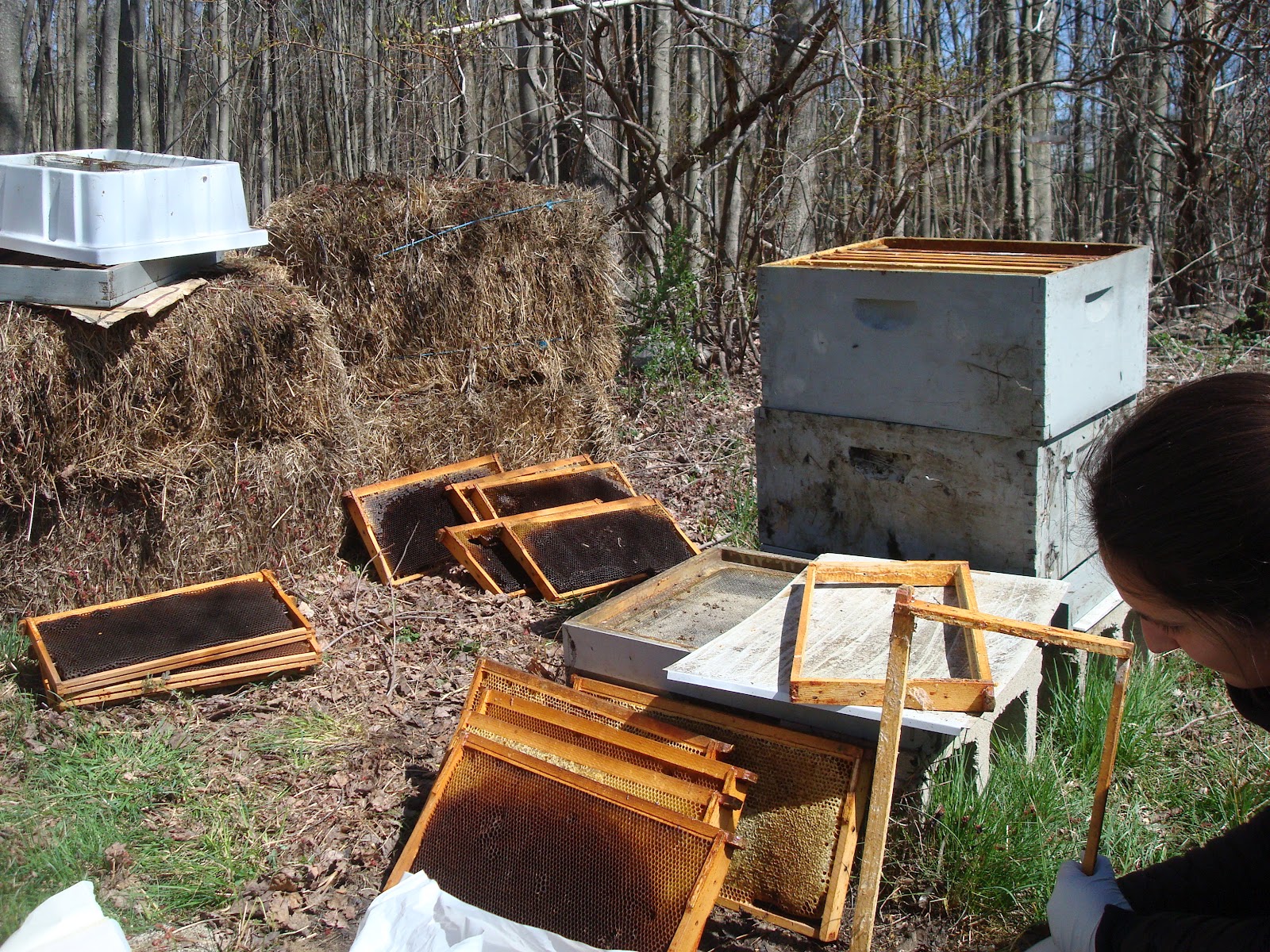
There are eight beehives scattered around a couple of sites on the farm we live on. A while ago I had the pleasure of observing our bee keeper add a new group of bees to one of our hives that did not survive over the winter. The process was fascinating.

First, we had to do some cleaning.


You can see in the picture above that we have taken a bunch of frames of honeycomb out of the bee box. The bees don’t care that the frames are blackened from use or even that mice may have eaten holes out of the framed honeycomb. They will reconstruct it all like new this year.  We do scrape off areas with chunks of a substance called propolis so that the frames will fit more securely into the hive. Propolis is a secondary product made by the bees. In the photo below you’ll notice that the wood frame looks like it has a golden varnish.  


This varnished look was achieved through the application of propolis by the bees themselves! They manufacture this substance in a process similar to making honey, but instead of using flower nectar, they use sap from trees. (That last part just blew my mind). And then they apply the propolis to any areas of the hive that they want to make more secure. They also use it for its antibacterial properties. If they think a part of the hive is susceptible to disease for some reason, maybe mouse droppings, they will cover that area with the propolis and the hive will remain healthy. 

After the cleaning we put the hives back together, and added the bees to an empty box below so that they could find their own way into their new home.


Another interesting fact I learned is that honey bees are not native to North America. They were brought over by the European settlers. Apparently Native Americans called the honey bee the “white man’s fly” because the honey bee’s movement westward across the continent always preceded the inevitable arrival of Europeans.

Over the course of the afternoon I learned a lot from our enthusiastic bee keeper, but I was also surrounded by flying, buzzing bees the entire time. So, as I was doing my best to concentrate on all the knowledge she was providing, I was also attempting to conjure my absolute most Zen countenance. I thought that, if I was very peaceful and unafraid, the bees wouldn’t bother me. And they didn’t. After it was all done I felt a bit of a rush, as if I had just performed some dangerous act! I suppose hanging out with some bees is as exciting as I need life to get.


I learned so much that afternoon, that I cannot possibly fit it all in tonight. And I also need to save time to put up some more ridiculously cute lamb photos.

Monday, April 9, 2012

All My New Friends Are Really Cute


Every morning when Lesley and I walk to work, there is a chance that we will see a newborn lamb. Needless to say, I like going to work a lot. So far, there are five little lambs running around the farm, and there will be at least seven more in the next week or so if everything goes well. Here are a few pictures of the new arrivals. 


Sunday, April 1, 2012

Mystery at the Farm #72


It was a dark and stormy night…
And we were wondering why some of our seedlings wouldn’t grow.
Exhibit A:


Blood Sorrel and Good King Henry are actually supposed to be particularly hardy leafy greens. So it surprised us when no single plant emerged after seeding on February 21st.
Exhibit B:
The plot thickened when we compared lettuce plants that were seeded at different dates. Here we see that the Nancy lettuce plants seeded on March 7th are not growing as quickly as the lettuces seeded a week later, March 13th.
 The weather was very good following the first batch, so we have ruled out weather related problems.
Exhibit C:
Another March 7th seeding completely failed.


Our fellow apprentice Katie was disappointed when her herb seedlings of calamint wouldn’t take off. We were about to find out that it was more than a novice mistake.
Findings:
When the farm’s copy of Farmers’ Almanac 2012 arrived in the mail we used it as an investigation tool for our mystery. The Farmers’ Almanac has been published every year since 1818 and is still an invaluable resource for farmers.
We checked the section of the publication called Gardening with the Moon. There is a short explanation that you can see in the photo below.


And here’s what we found:
February 21-22: described as “Barren days”.  We planted the Good King Henry and Blood Sorrel on Feb. 21st. This indicates that it is not a good time to plant seeds
March 5-8: is described as, “A most barren period”! This is when we planted the lettuces and herbs that didn’t work out!
Is it really possible that the Farmers’ Almanac could predict what would happen to our plants when seeded during specific phases of the moon? To me, it seems almost supernatural and very hard to believe. But at the same time, this publication has provided highly trustworthy information to farmers for almost 200 years. 


I decided to do a little more research and found some scientific evidence to back up our findings. We have all heard that the ocean’s tides are governed by our moon. I learned that the tides are highest during the full moon and the new moon. At these times the moon’s gravitational pull is at it’s highest. But it affects more subtle bodies of water too, including moisture in the ground. So if we plant seeds during the full or new moon, they will absorb more moisture and grow more vigorously.
In contrast, during the half-moon following the full-moon the gravitational pull is at it’s lowest point and so seeds have a harder time germinating.  This is when we planted the seeds in question above.
Somehow the moon can even tell us when “…seeds will rot in the ground”. The Almanac predicted this for last Wednesday and Thursday March 28th and 29th. So we decided to take the almanac’s advice and hold off seeding more lettuces until Friday.
This theory has much more depth than what I’ve summarized here. If you’re interested you can learn more at: www.gardeningbythemoon.com
I suppose we can't say for sure if the mystery was truly solved. There are so many factors that play into the success of any growing thing. And as a beginning farmer, it would take me a while to see all the variables. But I must say, this mystery made me a believer in gardening by the moon!